Quick answer: Ear-clip anti-sleep alarms use a tilt switch that beeps after your head drops — meaning after you've already fallen asleep. AI camera apps track your eyes and detect drowsiness before sleep onset, warning you while you can still act. For most drivers, a free eye-tracking app like WakeGuard outperforms any head-tilt device.
The three types of anti-sleep alarm
1. Ear-clip head-tilt buzzers ($10–$30)
How they work: a small tilt switch hooks behind your ear. When your head pitches forward past ~15–30°, it beeps.
The problem is physics: the head-drop is the last event in the falling-asleep sequence — it happens because your neck muscles have already lost tone, which happens because your brain is already asleep. A head-tilt alarm is a notification that you fell asleep, delivered while your car travels 100+ feet per second unattended. Real-world complaints are consistent: false beeps when checking mirrors or blind spots, missed events when the head sags slowly, ear discomfort — and the quiet fact that a beep in one ear may not cut through a genuine microsleep at all.
2. Dash-mounted motion/posture gadgets ($30–$80)
How they work: infrared or motion sensors watch head position from the dash, or accelerometers infer fatigue from steering patterns.
Better, still indirect: posture-only devices share the "alerts after the drop" flaw; steering-pattern devices alert earlier but false-alarm on rough roads and can't distinguish fatigue from distraction. None of them see the actual leading indicator: your eyes.
3. AI eye-tracking apps (free–$)
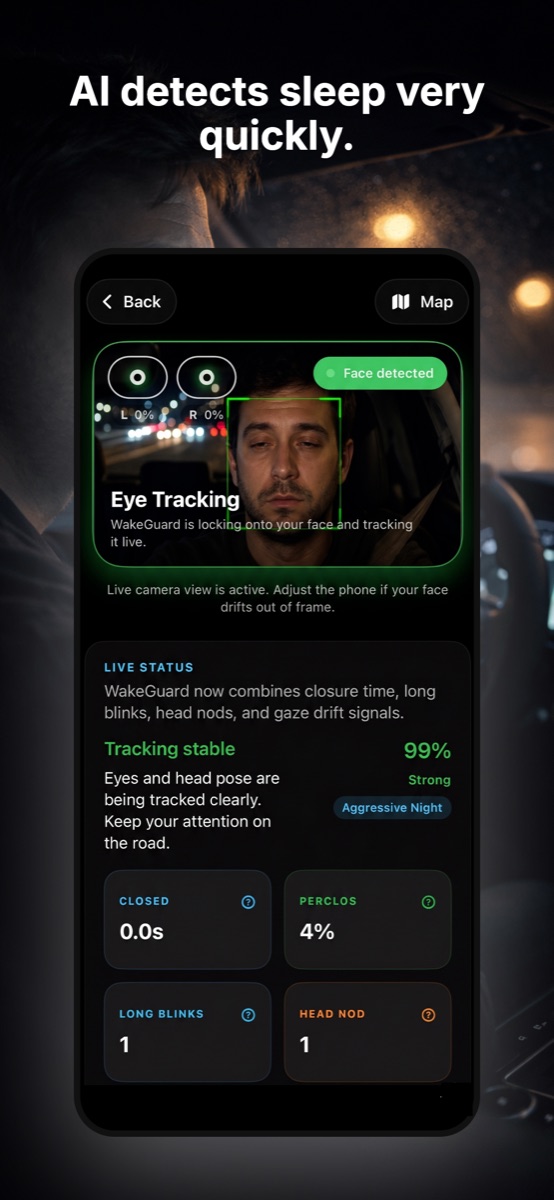
How they work: your phone's front camera plus on-device AI measures the signals drowsiness researchers actually validate — eye-closure duration, blink speed, PERCLOS (the eyelid-closure metric used in trucking-industry fatigue science), head pitch and gaze drift. It's the same approach as the driver-monitoring cameras in premium cars and commercial fleets, running on hardware you already own.
The decisive difference: eyes degrade minutes before the head drops. Camera systems warn during the slow-blink phase — while you're still awake enough to take an exit.
Head-to-head comparison
| Ear-clip buzzer | Dash gadget | WakeGuard (AI app) | |
|---|---|---|---|
| What it measures | Head tilt | Posture / steering | Eyes, blinks, PERCLOS, head, gaze |
| Warns before sleep onset | No | Rarely | Yes — escalating early warnings |
| Works for slow eyelid-droop (no head drop) | No | No | Yes |
| Alarm strength | Beep in one ear | Beep/chime | Full-screen siren + Apple Watch haptics, dismiss-only-by-you |
| False-alarm source | Mirror checks | Rough roads | Adjustable sensitivity profiles |
| Trip insights | None | None | Drive Report + Protection Log |
| Comfort | Clip on ear for hours | None | None — phone sits in its mount |
| Cost | $10–$30 | $30–$80 | Free download |
Skip the gadget. Use the phone you own.
WakeGuard gives you fleet-camera-class eye tracking, an unmissable dual alarm and a post-drive report — free, on-device and private. Your ear stays clip-free.
Switching from a buzzer to WakeGuard
If you bought an ear-clip alarm (or were about to), here's the upgrade path:
- Get a phone mount if you don't have one ($10–15 — probably less than the buzzer). Position it so the front camera sees your face.
- Download WakeGuard, tap start. "Face detected" confirms you're guarded — a live per-eye readout replaces blind faith in a tilt switch.
- Tune sensitivity to your driving. Conservative for daytime commutes; aggressive/Night Mode for the hours a buzzer was always going to fail you.
- Watch the early warnings do the job buzzers can't: WakeGuard tells you drowsiness is building — long blinks up, PERCLOS rising — minutes before any head-drop. That's your window to stop safely.
- If it ever comes to the alarm, the full Wake Up Check fires on iPhone + Apple Watch and won't silence until you tap "I'm Awake." Then: next exit, 20-minute nap.
When a hardware device still makes sense
Fair is fair: if you ride a motorcycle (no mount point with a view of your face), routinely wear heavy sunglasses a camera can't see through, or need something with zero phone involvement, a physical device may fill the gap — just understand you're buying a late alarm, not an early warning. For everyone in a car or truck cab with an iPhone: the camera approach is simply a generation ahead.
Whatever you choose: no alarm — clip, gadget or app — makes drowsy driving safe. They exist to buy you the seconds needed to stop. If any of them fires, the drive is over until you've slept.