Quick answer: To stay awake driving at night: sleep before you go (even 90 minutes helps), time caffeine for the drive not before it, keep the cabin cool and bright-ish, stop every 90 minutes, and never rely on feeling alert — use rumble-strip awareness and an AI drowsiness alert app with night mode as your objective backstop. If your eyelids get heavy, stop; nothing else works.
Why night driving is different — the circadian trap
Between roughly midnight and 6 a.m., your circadian rhythm hits its lowest ebb. Core temperature drops, melatonin peaks, reaction time lengthens — regardless of how much willpower or coffee you apply. Crash-data analyses consistently show drowsy-driving crashes clustering in this window (with a second, smaller peak mid-afternoon). Add darkness itself — less visual stimulation, monotonous taillights, a warm cabin — and the highway at 2 a.m. becomes a sleep laboratory pointed at your driver's seat.
The most dangerous part: at night, drowsiness escalates faster than your self-awareness updates. The gap between "I'm fine" and a microsleep can be minutes.
Your night-drive survival plan
Before you leave
- Bank sleep. A 90-minute nap before a night departure is worth more than any amount of caffeine during it.
- Delay the drive if you can. Leaving at 5 a.m. after sleep beats leaving at 1 a.m. exhausted — same arrival, wildly different risk.
- Set your checkpoint plan. Decide now where you'll stop every ~90 minutes. Decisions made at 2 a.m. default to "keep going."
In the car
- Caffeine at the start of the danger window, not with dinner. Effects fade in 30–60 minutes; plan a second dose or a caffeine nap at a checkpoint.
- Cool cabin (65–68°F), cracked window. Warmth is sedation.
- Sit tall, cruise control off. Active pedal work keeps the brain in the loop.
- Talk or listen to something engaging — podcasts that make you think beat music that washes over you.
- Watch for Stage 2 signs: missed exits, speed wandering, heavy blinks. Our warning-signs guide ranks them; at night, skip a stage and act early.
The backstop: eye tracking that works in the dark
Every tactic above depends on a drowsy brain noticing its own decline — the one thing a drowsy brain is worst at. That's why night drivers benefit most from an objective observer. WakeGuard was built for exactly this scenario:
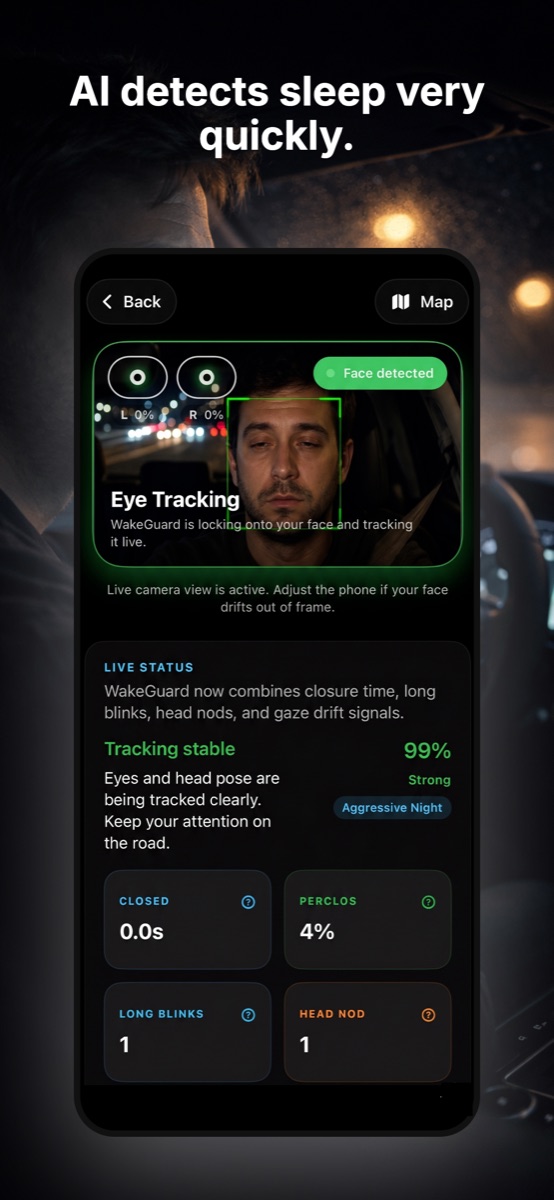
- Night Mode: detection tuned for dark cabins, using the glow of your dash and screen — no interior light needed. You'll see "Face detected" confirmation before you pull out.
- Adjustable sensitivity: switch to a more aggressive profile (e.g. "Aggressive Night") for the midnight–6 a.m. window, so warnings come earlier when the stakes are higher.
- Early warnings: as long blinks and PERCLOS climb, WakeGuard tells you drowsiness is building — your cue to hit the next checkpoint instead of pushing to the one after.
- The alarm: eyes closed too long and a full-screen Wake Up Check fires with sound on your iPhone and haptics on your Apple Watch — deliberately hard to ignore, impossible to dismiss without tapping "I'm Awake."
- No silent failures: if darkness or angle ever interrupts tracking, WakeGuard warns you instantly, so you never assume protection you don't have.
Driving tonight? Don't do it unguarded.
Free download, under a minute to set up, works in the dark. Urgent alarms on iPhone + Apple Watch the moment your eyes stay closed too long.
When to abort the night drive
Some signals mean the plan has failed and continuing is gambling:
- You hit rumble strips or catch yourself drifting
- You experience a head nod or a "lost mile"
- WakeGuard fires a Wake Up Check more than once
At that point: next exit, doors locked, 20-minute nap. If it's recurring — like a nightly commute — read our night-shift driving guide; the fix there is structural, not tactical.
Remember: WakeGuard is a support tool, not a pass to drive exhausted. The alarm exists to hand you back the seconds you need to get off the road — use them.