What is a microsleep? A microsleep is an involuntary episode of sleep lasting from a fraction of a second up to about 30 seconds. Your eyes may stay partially open and you usually don't realize it happened. At 70 mph, a 5-second microsleep means traveling more than 500 feet — one and a half football fields — with no one driving.
What a microsleep feels like (and why you miss it)
Most people imagine falling asleep at the wheel as a slow, obvious drift. It isn't. A microsleep feels like a skip in time: a head jerk, a blink that lasted too long, suddenly being closer to the car ahead, or missing the last exit sign entirely. Common experiences drivers report:
- A sudden head nod or chin drop, followed by a jolt of adrenaline
- "Waking up" mid-lane-drift, sometimes to the sound of rumble strips
- No memory of the last mile or two of road
- Eyes open, but staring — the brain offline while the eyelids aren't
That last one is why microsleeps are so treacherous: you can be asleep with your eyes partly open. Your brain enters a sleep state and simply stops processing the road. Researchers detect these episodes with EEG in labs — on the road, the earliest visible signals are in your eyelids and head movement.
Why microsleeps happen to alert-feeling drivers
Microsleeps are caused by sleep pressure — your brain's build-up of adenosine after too long awake — colliding with your circadian rhythm's low points (midnight–6 a.m. and mid-afternoon). Crucially, drowsiness impairs your self-assessment before it impairs your driving. Studies consistently find drivers rate themselves "fine" minutes before recorded microsleep episodes. You are, biologically, the worst-placed observer of your own drowsiness.
The warning signs that precede a microsleep
Microsleeps rarely arrive without a build-up. In the minutes before, drowsiness science identifies a measurable cascade:
- Slow blinks — blink duration stretches from ~150 ms to 500 ms+
- Rising PERCLOS — the percentage of time your eyelids cover the pupil climbs (the same metric used in trucking-industry fatigue research)
- Gaze drift — your eyes stop scanning mirrors and fixate straight ahead
- Head pitch changes and micro-nods — neck muscles briefly lose tone
- Long closures — the final stage: eyes shut for 1–2 seconds at a time
You can't watch your own eyelids. But a camera can — which is exactly the approach modern drowsiness detection apps and in-cab fleet systems take.
WakeGuard watches for exactly these signals
On-device AI tracks blink duration, PERCLOS, gaze drift, head pitch and eye-closure time in real time — and fires an urgent iPhone + Apple Watch alarm before drowsiness becomes a microsleep.
How WakeGuard catches the cascade in real time
Mount your iPhone facing you, start eye tracking, and drive. Here's what happens under the hood:
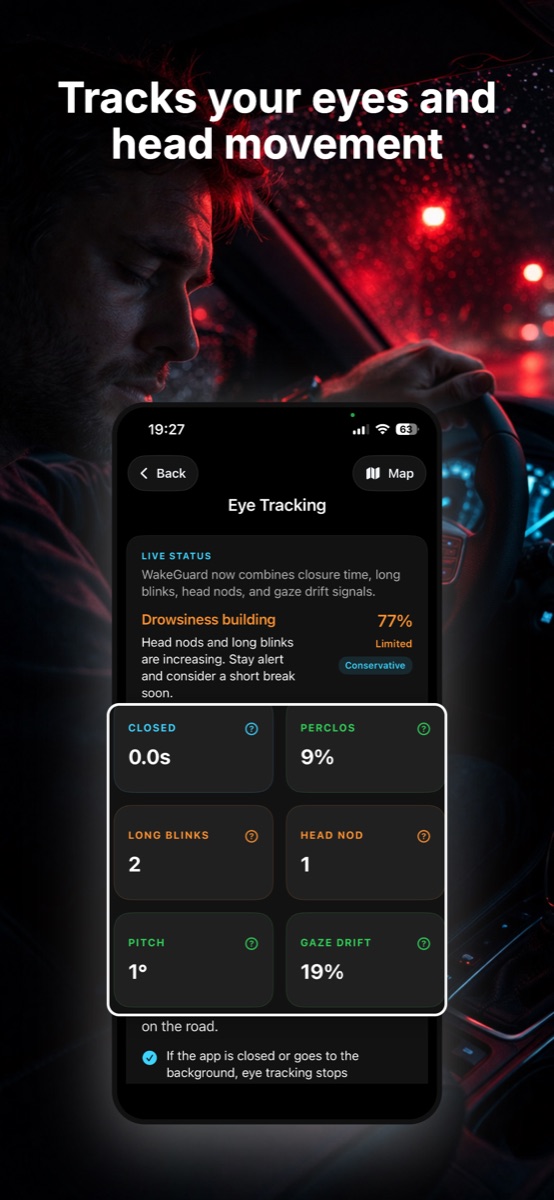
- Continuous measurement: WakeGuard's AI reads your eyes and head pose many times per second, tracking the same signals used in drowsiness research — closure time, PERCLOS, long blinks, head nods and gaze drift. You can see them live on the tracking screen.
- Early warning: when the combined risk score climbs — say your PERCLOS rises and long blinks increase — WakeGuard tells you drowsiness is building before the dangerous stage, so you can plan a stop.
- The moment that matters: if your eyes stay closed too long, the full-screen Wake Up Check alarm fires instantly on your iPhone and vibrates your Apple Watch. It keeps sounding until you tap "I'm Awake" — a deliberate design, because a microsleeping brain ignores gentle chimes.
- No silent failures: if your face drifts out of frame or tracking is interrupted, WakeGuard warns you immediately. You'll never think you're guarded when you aren't.
If you've already had a microsleep behind the wheel
Treat it as the red-line warning it is:
- Right now: exit the road at the next safe opportunity. A 20-minute nap is the only genuine reset — caffeine and cold air only mask the danger.
- This week: look at when it happened. Night drive? Post-shift commute? Under-slept? That pattern will repeat. Our guides on night driving and post-night-shift commutes cover the two most common scenarios.
- Every drive after: run a guard. One microsleep strongly predicts more — and the next one gets no warning either.
Important: frequent microsleeps or crushing daytime sleepiness can indicate a sleep disorder such as sleep apnea. WakeGuard is a support tool, not a medical device — talk to a doctor if this keeps happening.