Quick answer: The key warning signs of drowsy driving are frequent yawning, heavy eyelids and slow blinks, wandering thoughts, missed exits or signs, lane drifting, hitting rumble strips, and head nods. If you experience lane drift, a head nod, or can't remember the last few miles, pull over immediately — those are signs of microsleep, not just tiredness.
Stage 1 — Early signs: start planning a break
1. Yawning and eye-rubbing you can't stop
Repeated yawning is your brain flagging rising sleep pressure. One yawn means nothing; a yawn every minute is a trend line.
2. Heavy eyelids and slower blinks
Blinks stretch from a flick to a linger. Researchers measure this as blink duration and PERCLOS (the percentage of time your eyelids cover your pupils) — it's the single most validated predictor of drowsy-driving impairment, which is why fleet monitoring systems and drowsiness detection apps track it.
3. Wandering, disconnected thoughts
You catch yourself daydreaming and can't recall what you were thinking about. Cognitive drift precedes visual drift.
4. Restlessness and position-shifting
Constantly adjusting your seat, gripping the wheel differently, fidgeting — your body is fighting to stay engaged.
Stage 2 — Serious signs: take the next exit
5. Missing exits, signs or turns
If road information is sliding past unprocessed, your attention system is already failing intermittently.
6. Trouble holding speed
Unintentional slowing then surging back up is a classic fatigue signature — your vigilance is cycling.
7. Tailgating without noticing
Degraded distance judgment means degraded reaction margin, exactly when your reaction time is also slowing.
Stage 3 — Emergency signs: stop driving now
8. Drifting out of your lane
Lane drift means your brain briefly stopped steering. The next drift may not end at the line.
9. Hitting rumble strips
Rumble strips exist because enough drivers fall asleep to justify carving grooves into every highway. Being saved by one means you were asleep.
10. Head nods and "lost miles"
A chin drop, a head jerk, no memory of the last stretch of road — these are microsleeps. You have already fallen asleep at the wheel; the only question is for how long next time.
The problem: drowsiness blinds you to these signs
Here's the cruel design flaw: fatigue impairs the brain region doing the self-assessment. Studies repeatedly show drivers rating themselves "alert" minutes before recorded microsleeps. The signs above are real, but the person supposed to notice them is compromised. That's why the safest setups add an objective observer — either a passenger watching you, or a camera that never gets tired.
Let AI watch for the signs you can't feel
WakeGuard tracks slow blinks, PERCLOS, gaze drift and head nods in real time and alarms on iPhone + Apple Watch when risk rises. Free, on-device, private.
How WakeGuard maps to each stage
- Stage 1 (early): WakeGuard's live status shows drowsiness building — you'll see the risk score climb as long blinks and PERCLOS rise, with a message like "Head nods and long blinks are increasing. Stay alert and consider a short break soon." That's your cue to plan a stop on your terms.
- Stage 2 (serious): early warnings escalate. The app is now telling you what a good co-driver would: this is no longer optional.
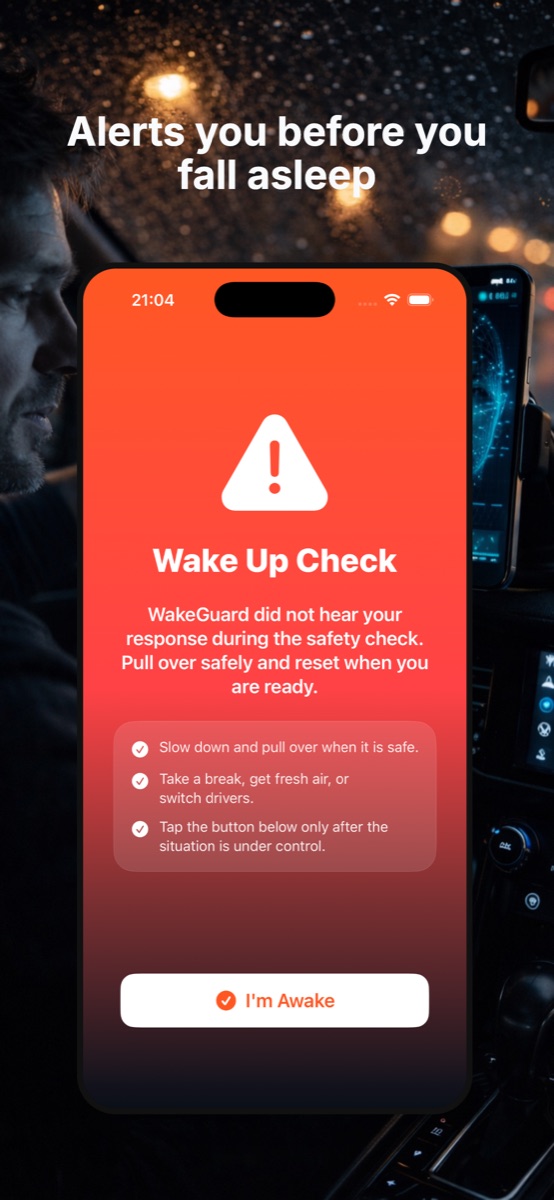
- Stage 3 (emergency): the moment your eyes stay closed too long or your head drops, the full-screen Wake Up Check alarm fires on iPhone and buzzes your Apple Watch — and won't stop until you tap "I'm Awake."
- After the drive: the Drive Report shows how many long closures and early warnings you actually had. Many drivers are shocked the first time — it's an honest mirror of drives that "felt fine."
If you're seeing Stage 3 signs regularly: that's not a gadget problem, it's a sleep problem. Chronic drowsy driving can indicate sleep deprivation or a disorder like sleep apnea — worth a conversation with a doctor.